
How to Start an Ecommerce Business
A Step-By-Step Guide for Beginners
- by Casper du Toit
- Updated: October 21, 2024
BrandMoth primarily focuses on helping entrepreneurs and startups choose the right brand name and domain for their business. However, many of my customers want to start an ecommerce business (good idea!) but are unsure how to get started.
In this article, I cover the principles of starting an ecommerce business in seven steps. It will give you more clarity on how to start your business on a solid foundation and what steps to take next.
Starting an ecommerce business is very popular with entrepreneurs wanting to benefit from the massive ecommerce market. Although there are already many players in this space, the ecommerce market is growing and far from saturated. Your slice of the pie is waiting!
According to the latest statistics from the U.S. Census Bureau, retail ecommerce sales were an estimated $291.6 billion for the second quarter of 2024. That equates to 16% of total retail sales for the quarter.
Table of Contents
If you are thinking of starting an ecommerce business, there is no time like the present!
Entering the ecommerce market can be daunting for beginners. However, there is no need to overcomplicate it.
The basic concept is simple: Buying and selling products over the internet.
You can compare an ecommerce business to a traditional brick-and-mortar shop that buys and sells products, except your customers are online. But unlike a brick-and-mortar shop, you can reach a wider audience, work from home, and have much lower overheads.
However, like any other business, you need to invest in your business and see yourself as the owner of a startup. Starting an ecommerce business is not a get-rich-quick scheme. It will take time and hard work, but if you persevere it can be highly rewarding.
Step 1. Choose Your Niche and Business Model
Choose Your Niche
Your niche is the segment of the market you want to focus on. It is the first important decision you make when starting an ecommerce business, and many marketers get it wrong.
Some marketers believe you should only focus on selling trending products that will give you a good return after ad spend. They advocate that it does not matter what niche you choose. Their strategy is to find products that sell well, locate the manufacturer, and copy (steal) the seller’s ad copy.
This strategy can work. However, it sounds much easier than it is. They are typically unable to build a strong brand and create a rapport with their target audience. In addition, running ads are expensive and require a lot of testing. Furthermore, trending products come and go. I would describe this approach more as opportunistic selling than an ecommerce business.
A niche helps you focus and align your brand and products to a specific audience. Trying to serve many industries can spread you too thin and waste resources.
For example, promoting handbags and dog food on one website or social media account will hamper your ability to attract the right target audience. Plus, setting up and managing different ecommerce websites and social media accounts for different industries is a headache.
Starting and scaling an ecommerce business is not a walk in the park. For this reason, I suggest you either:
– Choose a niche you are passionate about
– Choose a niche you know and understand
If no ideas come to mind, look at popular niches on Amazon for inspiration. You can also walk through Walmart to get product ideas. Focus on products that appeal to you, for example, products for your home or kitchen.
Note that if you want to sell your products on Amazon, some categories are restricted and require approval. Getting approved to sell in gated or restricted categories might be challenging if you are a new Amazon seller.
Types of Ecommerce Business Models
– Source: Investopedia
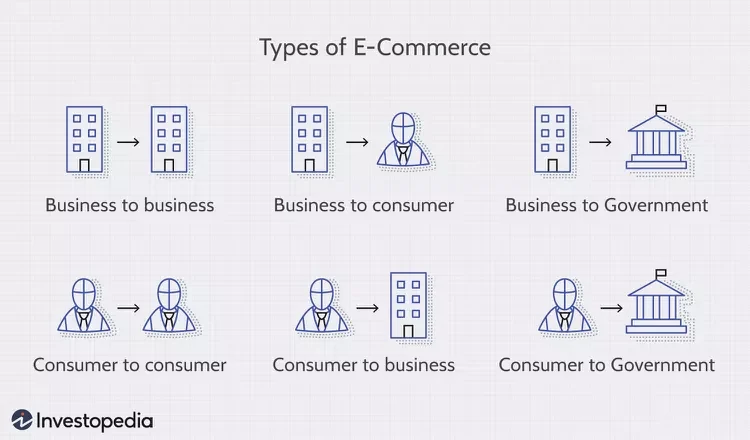
There are six major types of ecommerce business models:
Most entrepreneurs register a business and sell directly to consumers (D2C) from their ecommerce website or through an ecommerce platform, such as Amazon.
- Business-to-consumer (B2C) – Sell your company’s products or products from another party to consumers.
- Business-to-business (B2B) – Sell your company’s products or products from another party to other businesses.
- Business-to-government (B2G) – Sell your company’s products or products from another party to government agencies.
- Consumer-to-consumer (C2C) – When you sell goods as an individual to other consumers. Popular platforms or marketplaces include Facebook Marketplace, eBay, and Craigslist.
- Consumer-to-business (C2B) – When you sell goods as an individual to businesses.
- Consumer-to-government (C2G) – When you sell goods as an individual to government agencies.
Step 2. Choose a Brand Name and Domain
“Brand is what a human being feels about you”
- Gary Vee Tweet
“Your brand is what other people say about you when you're not in the room”
- Jeff Bezos Tweet
Choosing the right brand name is one of the most important decisions you need to make. Think of it as naming your child. It requires careful consideration and is hard to change afterward.
Tips for choosing a good brand name
- Keep it short – The best brand names typically do not exceed eight letters or more than two words.
- Choose a memorable and catchy name – Your brand name should be easy to pronounce, spell, and remember.
- Do not use a brand name to describe your business – Your brand name can suggest your type of industry, but it should be unique and not too descriptive. For example, instead of choosing Plumbing Service, choose Plumbit. Use your brand name to differentiate your business from competitors.
- It should have a matching .com domain – Despite the hundreds of domain extensions available, .com remains king! The last thing you want is for your competitor to own the dot com and for your customers to type dot com instead of your extension.
- It should leave room for expansion – One of the most common mistakes startups make is choosing a name that inhibits growth or expansion. For example, if your brand and domain name is Kitty Cat, it would practically be impossible to expand into the dog niche. That’s unless you start a new brand.
- Choose the right type of brand name – There are many types of brand names but not all of them are suitable for ecommerce. Instead of looking for the proverbial needle in a haystack, familiarize yourself first with the different types of brand names. It will give you a better idea of what types of brand names to look for.
Step 3. Define Your Target Audience
Your target audience is the segment of consumers you believe are the most interested in what you offer and most likely to buy your products.
Defining your ideal audience is not a guessing game and should not be based on assumptions. Furthermore, do not try to invent an audience or create demand for products your audience is unfamiliar with.
Know Your Target Audience
Ideally, the best way to understand your target audience is to be part of it. The better you know your audience and what makes them tick, the better you can reach them and turn them into customers.
For example, what are their interests? How much money are they prepared to spend on solutions for their problems? What are their buying criteria? Where do they shop? How long are they prepared to wait for delivery?
Note that by problems, I do not necessarily mean problems in the literal sense. It can be any need or want they have.
– Needs are essential for your survival or to keep up your standard of living.
– Wants are non-essential items that make life more enjoyable.
Be problem-aware and understand their pain points. Offer them a solution by giving them what they need or want.
Drill Down Through Market Segmentation
Segment your ideal audience into subsets. It includes their demographics, gender, income level, needs, and wants.
For example, not everyone is looking for the same type of car. Some consumers want luxury vehicles like Mercedes, Lexus, Audi, or BMW. However, for some consumers, these brands are not luxurious enough – they want a Rolls-Royce or Bentley.
Before you start finding products to sell, consider what subset of your broader target audience you want to focus on. It will have a direct impact on your brand positioning.
Step 4. Find Products to Sell
Once you have chosen a niche, defined your target audience, and know their pain points, you might already know what products you want to sell.
However, there are potentially thousands of products your target audience might be interested in. One of the best places to find product ideas is Amazon.
By clicking on any of the departments you are interested in, Amazon will show you the best sellers in that category. Look at all the products in that category, not only the best sellers.
These are products (updated daily) most often added to Wishlists. Click on any of the departments you are interested in for more details.
These products have increased the most in sales rank over the past 24 hours. Click on any of the departments you are interested in for more details.
When looking at a product, look at similar or frequently bought together items or products Amazon thinks you might be interested in for more ideas.
In addition to the above, you can use Amazon’s Product Opportunity Explorer tool to search for products by category, keyword, or ASIN (Amazon Standard Identification Number). It shows brand details, trends, demand, price details, and customer sentiment. (Note that you have to log into your Amazon Seller Central account to access it)
The following three tools can give you valuable insights into consumer trends:
Step 5. Research Your Competition and Spot Opportunities
In the previous step, I covered how to find products to sell using Amazon, as the platform has millions of products for sale. Once you have identified suitable products, it is time to research your competitors.
One of the best ways to research your competitors and find opportunities is to read customer reviews. It should give you a good indication of what customers like and dislike about their products. Keep this in mind when you search for a supplier or manufacturer to find products that can give you an edge over your competitors.
If you want to take a deep dive into what products are selling well on Amazon and your competitors, I highly recommend you check out the following seller software companies:
However, competitive analysis goes way beyond only reading customer reviews. It involves understanding the strengths and weaknesses of your competitors and analyzing their pricing, strategies, and business models.
Benchmark Comparison
Select three to five successful competitors focusing on the same target audience for benchmark purposes. Here are some of the things to look out for:
– Sales activity on Amazon, if any.
– Ecommerce website and what platform they are using, such as Shopify.
– Keywords they are targeting to reach their target audience.
– Do they rank in Google search results, and for what keywords?
– What social media channels do they use? How active are they?
– Traffic sources – organic (free), paid ads, or both?
The following tools can help you analyze your competitors better:
– Ahrefs
– Semrush
Put yourself in the shoes of a potential customer. Follow them on social media and subscribe to their newsletter. What can you learn from them, and what can you do better?
Tips for Amazon Sellers
Amazon can be a potential goldmine for an ecommerce business. However, it is also a very competitive space. If you are a new seller, do not try to compete with brands and sellers with thousands of positive reviews.
Here are some tips that can help you:
- Avoid gated or restricted products: Some categories, such as supplements, require approval. It can be difficult for a new seller to obtain approval in a gated category.
- Sales price between $28 and $100: Look for products that sell for between $27 and $100. Only consider products that sell for less than $27 if you are not planning on spending money on ads.
- Amazon BSR under 100: Your competitors should not have an Amazon Best Sellers Rank (BSR) under 100.
- Less than 2,000 reviews: Your competitors should not have more than 2,000 reviews.
Step 6. Find Suppliers
By this stage, you have chosen your niche, defined your target audience, found products that appeal to your audience, and researched your competitors.
The next step is to find suppliers, either the same ones your competitors are using or alternative suppliers for the same products.
Here are some of the best ways you can find suppliers:
Search for Manufacturers on Google
Here are some search terms you can use to find suppliers on Google:
[product] manufacturers
[product] wholesalers
[product] private label
The first prize is to find suppliers that can offer you private label products you can sell under your brand name.
Use ImportYeti.com
ImportYeti works like a search engine to find what suppliers brands import their products from. You might have to search using their legal name or holding company to find their import statistics.
You can also use search by product or product categories to find the suppliers of importers.
Use Supplier Databases or Directories
Wholesale Central – a leading US B2B directory of wholesale product suppliers containing thousands of prescreened wholesalers, importers, distributors, dropshippers, and manufacturers.
TopTenWholesale.com – a sourcing platform that connects wholesale buyers with suppliers in the USA and abroad. According to the site:
“Millions of retailers, chain stores, boutiques, dropshippers, auctioneers, eBay & Amazon sellers, flea marketers, and other resellers have used TopTenWholesale.com to find wholesalers, manufacturers, importers, distributors, and trading companies.”
In 2008, JP Communications INC (parent company of TopTenWholesale.com) also acquired Manufacturer.com – a global business-to-business trade platform that connects buyers and sellers worldwide.
SaleHoo – has a directory of 8,000+ prevetted suppliers (over 2.5 million products) used by the world’s top sellers.
Worldwide Brands – has a certified directory of wholesalers and dropshippers (16+ million certified wholesale products) that work with online retailers.
Find Chinese Suppliers
Alibaba – the site contains 200+ million products from over 200,000 suppliers across 5,900 categories. Although not all the suppliers are Chinese companies, most are.
AliExpress – the platform belongs to the Alibaba Group. It consists of small businesses in China and other locations. Unlike suppliers on Alibaba that often have high minimum order requirements, AliExpress suppliers are more flexible.
Made in China – the platform has over 40 million products in 27 industries and 4,300+ categories. As the name suggests, they only list Chinese suppliers.
Note some Chinese suppliers may call themselves manufacturers, although they are only trading companies. Always do your due diligence before placing an order.
Try to have at least one back-up supplier.
As a rule, do not put all your trust in only one supplier. You might be out of business overnight if anything happens to that supplier! It will also give you leverage when negotiating with a supplier if you have other options.
Step 7. Evaluate Your Idea and Write a Business Plan
If you have followed the previous steps correctly, you now:
– have a niche,
– understand your target audience,
– have products you know your audience is interested in,
– know your competitors, and
– have at least one supplier.
Next, you should evaluate your idea and draw up a business plan.
Even if you are not planning on showing your business plan to anyone, it is good to put everything in writing. Your business plan will help you to identify if your idea is viable. And you can refer back to it when you have doubts, which you will have.
Product & Quality Considerations
You have likely identified several products worth pursuing, but I recommend you start with one product.
Placing an order with a supplier based on its description, images, and product price is insufficient.
I suggest you order and test samples from several suppliers. This way, you can ensure that you only work with suppliers that deliver high-quality products.
Profit Margin
One of the crucial considerations that will determine your success is your gross profit margin. New ecommerce sellers make the mistake of choosing products with many competitors where they have to slash their profit to the bone to be competitive. It leaves them no room for advertising and promotions or to absorb refunds and damages.
Choose products where you can earn a margin of at least 30%. And do not confuse margin with markup.
Your profit margin is your sales price less the cost of goods sold. Markup is the percentage you add to your product to determine its selling price.
For example, assume you are importing a product from China, and your landed cost in the US is $20. If you sell the product for $50, your gross profit is $30, and your profit margin is 60% – divide gross profit by revenue: $30 / $50 = 0.6 and express it as a percentage (0.6 * 100 = 60%).
Ad Spend
Spending money on ads will typically get you the fastest results. However, ads can be expensive. The cost of your ads will depend on the platform you are advertising on, how targeted your ads are, and the level of competition you face.
A typical ad spend goal is to achieve a ROAS (Return on Ad Spend) of 4:1. It implies that every $1 you spend on ads will generate $4 in revenue. For example, if you want $6,000 in revenue at a ROAS of 4:1, you spend $1,500 on ads.
The above is not an exact science. Achieving an ROAS of 4:1 is not necessarily easy and might not be sufficient depending on your gross profit margin.
However, to achieve fast results and spend money on ads, determine your ad costs and evaluate its viability.
Average ecommerce conversion rates are around 2.5% to 3%, but according to Shopify, the average conversion rate for Shopify stores is 1.4%.
So if you use ads to drive 1,000 visits to your ecommerce website that result in 30 orders, your conversion rate is 3% (30 / 1,000) = 0.03 or 3%. But depending on your product price, gross margin, and cost per click, even a 3% conversion rate can be insufficient.
Lead Time
How long will it take to fulfill orders? Importing low-cost products from countries like China might give you a price advantage. However, can your customers wait weeks to receive their goods, or do you have the funds to place bulk orders on your supplier(s)?
Brand Positioning
Why will customers buy your product(s)? What value do you offer?
As an example, think of three luxury car brands. Consider how the brands are positioned to appeal to a specific target audience.
What do you think and feel when you hear the name Mercedes? Typically, your answer will reflect what the brand wants you to think of it. It’s not by chance but part of a carefully structured strategy to influence consumers.
Brand positioning is the unique value a brand offers its customers. It’s part of their brand identity strategy and meant to convey their value proposition. It’s the reason a customer prefers their brand over other brands.
***
Let me know in the comments which of the seven steps you found the most useful. And if you are looking for a brand name, check out my brand names for sale.
Please Share on Social Media
